Anatomy of a Painting: Lionel St. Éloi’s Erzulie Freda Holding a Heart
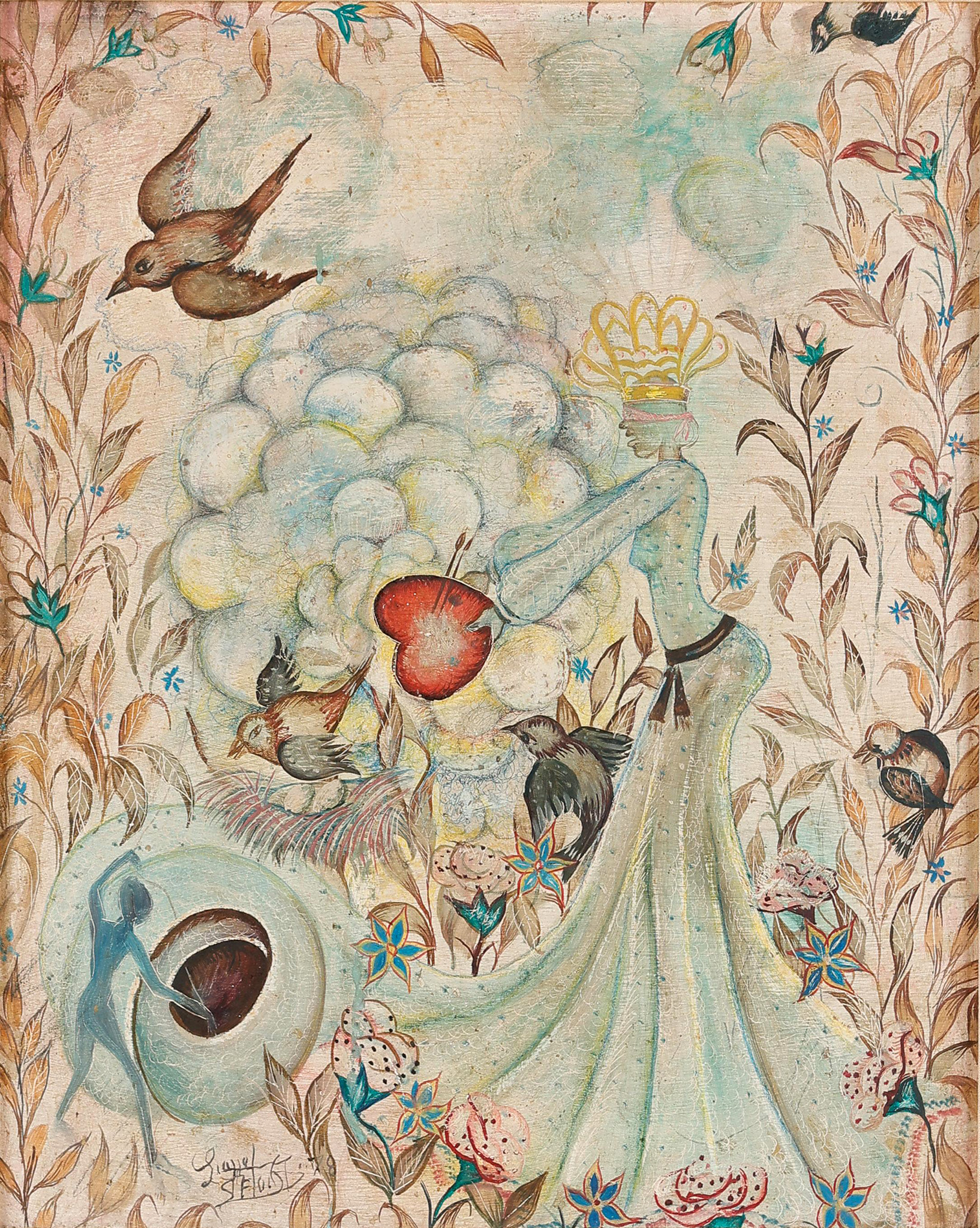
Lionel St. Éloi’s painting Erzulie Freda Holding a Heart (1978, oil on board) stands as a pivotal early work in the artist’s career.
Known today as an international master of recycled metal sculpture, St. Éloi began as a painter after joining Port-au-Prince's
Le Centre d'Art in 1972, where he was deeply influenced by the sacred visual traditions of Haitian Vodou.
Interpreting this work invites an examination of both Vodou cosmology and established frameworks of visual analysis, combining careful formal
observation with E.H. Gombrich’s theories of art and perception.
Description: Visual Inventory and Spatial Harmony
A systematic visual inventory reveals a dreamlike, pastel-toned composition enclosed within a botanical border of leafy vines and blue flowers. At the center stands a tall female figure in a flowing light blue gown, wearing a golden crown and a translucent blindfold. She presents a glowing red heart pierced by two arrows to the left.
Directly below the heart, a bird incubates eggs in a nest, while other birds hover in the sky and perch on surrounding flora. In the lower-left corner, a blue silhouette stoops over a circular, radiant vessel, holding a delicate cord that extends into its opening.
Design Principles and the Beholder’s Share
In examining the formal structure of the painting, St. Éloi deliberately rejects traditional linear perspective in favor of a flattened, symbolic space. The background cloud formations hover at eye level, and scale operates through spiritual hierarchy rather than spatial physics, allowing the central figure to loom with divine authority.
This spatial distortion engages what art historian E.H. Gombrich called "the beholder's share". By stripping away three-dimensional realism, St. Éloi relies on the viewer’s perception to bridge the visual gaps. The viewer stops attempting to read the painting as a physical space and begins interpreting it as a sacred diagram where proximity signifies spiritual relationship rather than literal distance.
Cosmology and Syncretic Iconography
Bridging these formal qualities to their deep cultural meaning reveals the central figure as Erzulie Freda, the lwa (spirit) of love, beauty, passion, luxury, and dream worlds. In Vodou cosmology, Erzulie embodies an ideal of pure emotional perfection. Yet, because human existence can never fully attain her ideal, her presence carries a poignant sorrow. Her love brings both supreme ecstasy and inevitable grief.
This duality is captured in the heart pierced by two arrows, which serves as Erzulie's primary visual symbol (vèvè). This imagery reflects historical syncretism. Following the Haitian Revolution, Vodou practitioners protected their faith under Catholic disguise, syncretizing Erzulie Freda with Catholic depictions of the Virgin Mary, particularly the Mater Dolorosa (Our Lady of Sorrows).
Her golden crown signals her royalty among the lwa, while her blindfold marks a fascinating subversion of Western art history. Where European iconography traditionally uses the blindfold to denote impartiality (Lady Justice), irrationality (Cupid), or spiritual blindness (Synagoga), here it signifies sacred clairvoyance. In Vodou practice, covered eyes signal trance or possession (chwal), indicating that physical sight has receded so divine consciousness can manifest.
In the lower left, the blue figure operates near a govi, a sacred clay jar housed in the inner sanctuary (djèvo) of a Vodou temple (ounfò) to hold ancestral spirits (gwo bonanj). The thread extending from the figure’s hand into the jar illustrates fè kòd (binding energy), a ritual practice used to direct spiritual force (pwen). This cord acts as a conduit between les visibles (the living) and les invisibles (the spirit realm).
Surrounding this ritual are birds, which serve in Vodou as messengers traveling between earth and sky, often associated with zanj (angels) or lwa. The nesting bird beneath the heart symbolizes the incubation of konesans (spiritual knowledge) and maternal protection, while the framing vines invoke Gran Bwa, the spirit of the forest and natural life force (ashe).
Haitian Surrealism in Art History
Evaluating the artwork's historical and aesthetic significance illuminates why French Surrealist theorist André Breton observed an intrinsic, unforced Surrealism in Haitian art upon his visit in December 1945. Rather than relying on intellectual exercises to unlock the subconscious, Haitian artists naturally translated their living spiritual universe into their work.
St. Éloi’s botanical framework recalls early Haitian masters like Hector Hyppolite and Rigaud Benoit, yet his light, ethereal linework creates an atmosphere uniquely his own. Lionel St. Éloi’s painting succeeds because it is not merely a passive representation of myth, it functions as a visual altar, harmonizing Catholic iconographic history with Vodou ritual practice through the transcendent language of Surrealism.
Matt Dunn, July 2026